The Mass Constraint
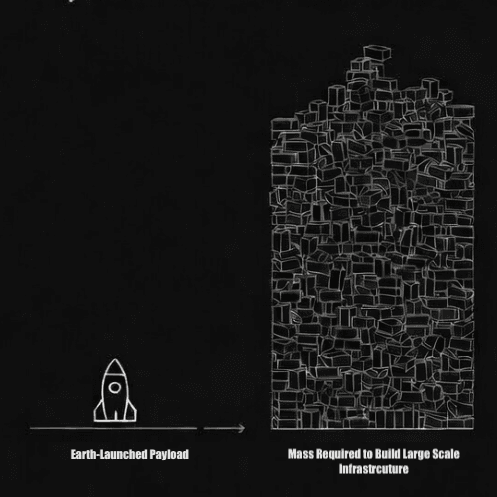
Permanent space infrastructure fails for a single, unavoidable reason: material mass.
Radiation shielding, pressure vessels, structural supports, and thermal protection all require large quantities of matter. For long-duration habitation beyond Earth’s magnetosphere, radiation shielding alone demands multiple tons of material per square meter. Structural mass compounds this requirement, increasing shielding needs further.
Even with fully reusable launch systems, delivering bulk material from Earth remains constrained by physics. Every kilogram launched must overcome Earth’s gravity well, be accelerated, transferred, and inserted—each step compounding cost, complexity, and risk.
The result is not a marginal limitation, but a categorical one:
Earth-launched mass cannot support infrastructure at the scale required for permanent human presence in space.
Any architecture that depends on Earth for bulk materials remains temporary by design.