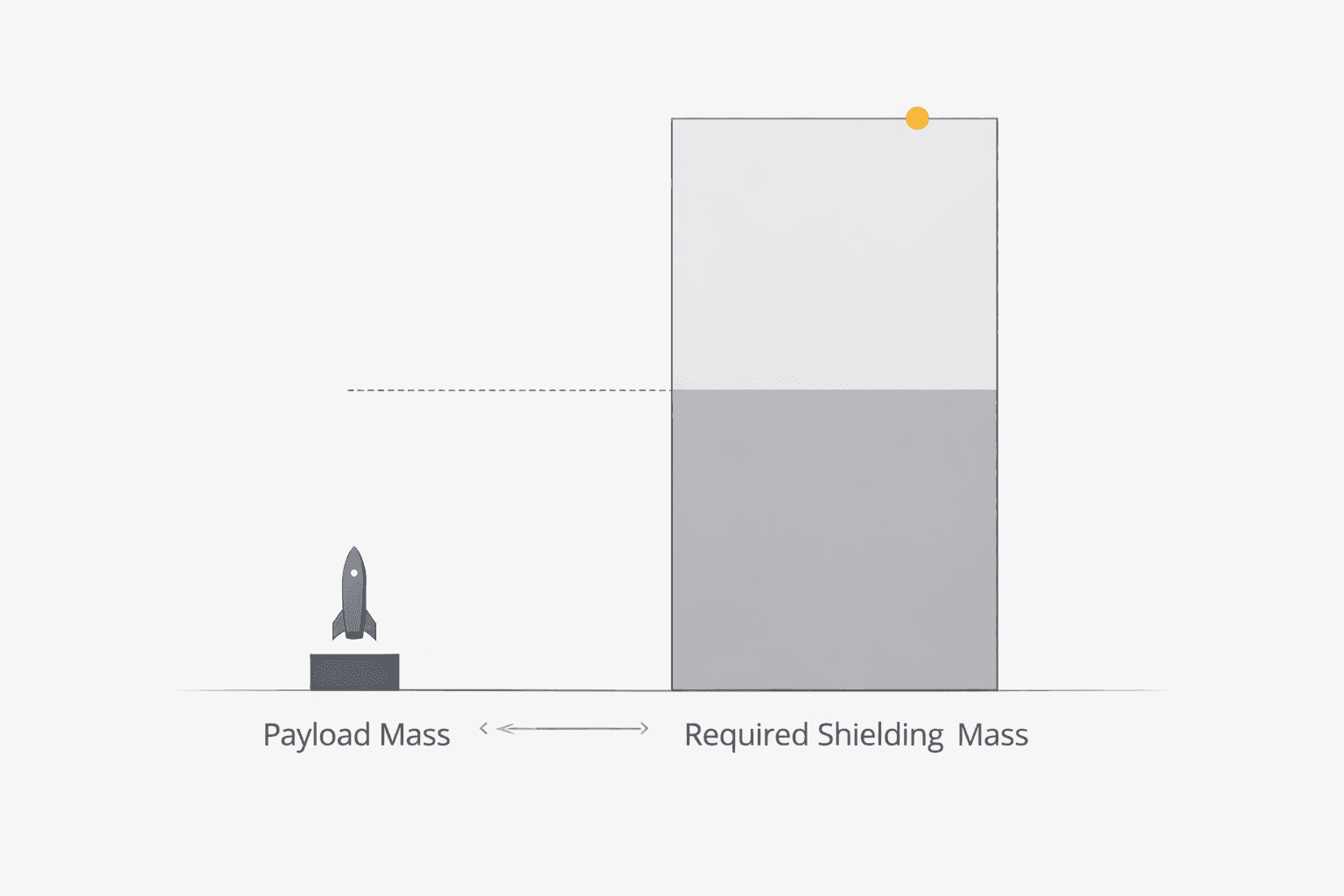
Every proposal for long-duration space infrastructure encounters the same limiting factor: material mass. This constraint is not economic, political, or technological in origin. It is physical. Until material supply is decoupled from Earth, space infrastructure remains fundamentally limited in scale and duration.
In space system design, mass is the governing variable from which nearly all other constraints follow.
Radiation protection, pressure containment, thermal stability, and structural integrity are not abstract requirements. They are provided by physical matter arranged in sufficient quantity. Unlike power generation or data handling, material mass cannot be substituted, virtualized, or optimized away beyond fundamental limits.
As infrastructure increases in size and duration, mass requirements grow accordingly. Larger volumes require thicker shielding. Longer operational lifetimes require greater redundancy and structural margin. Each added function introduces additional material demand, creating a system in which mass availability sets the upper bound on what can be built and sustained.
This is why access to space alone does not determine scalability. The decisive factor is access to material at scale. Without it, infrastructure remains constrained to short-duration, tightly mass-limited configurations.