The Inflection Point

Why lunar industry becomes viable now - through the convergence of access, resources, and sustained demand.

For decades, lunar industrialization has been discussed as a long-term possibility. The underlying idea was sound, but the conditions required to make it viable did not exist simultaneously. That has now changed.


This page explains why lunar industry becomes feasible not because of a single breakthrough, but because multiple constraints have shifted at the same time.

Why This Was Not Possible Before

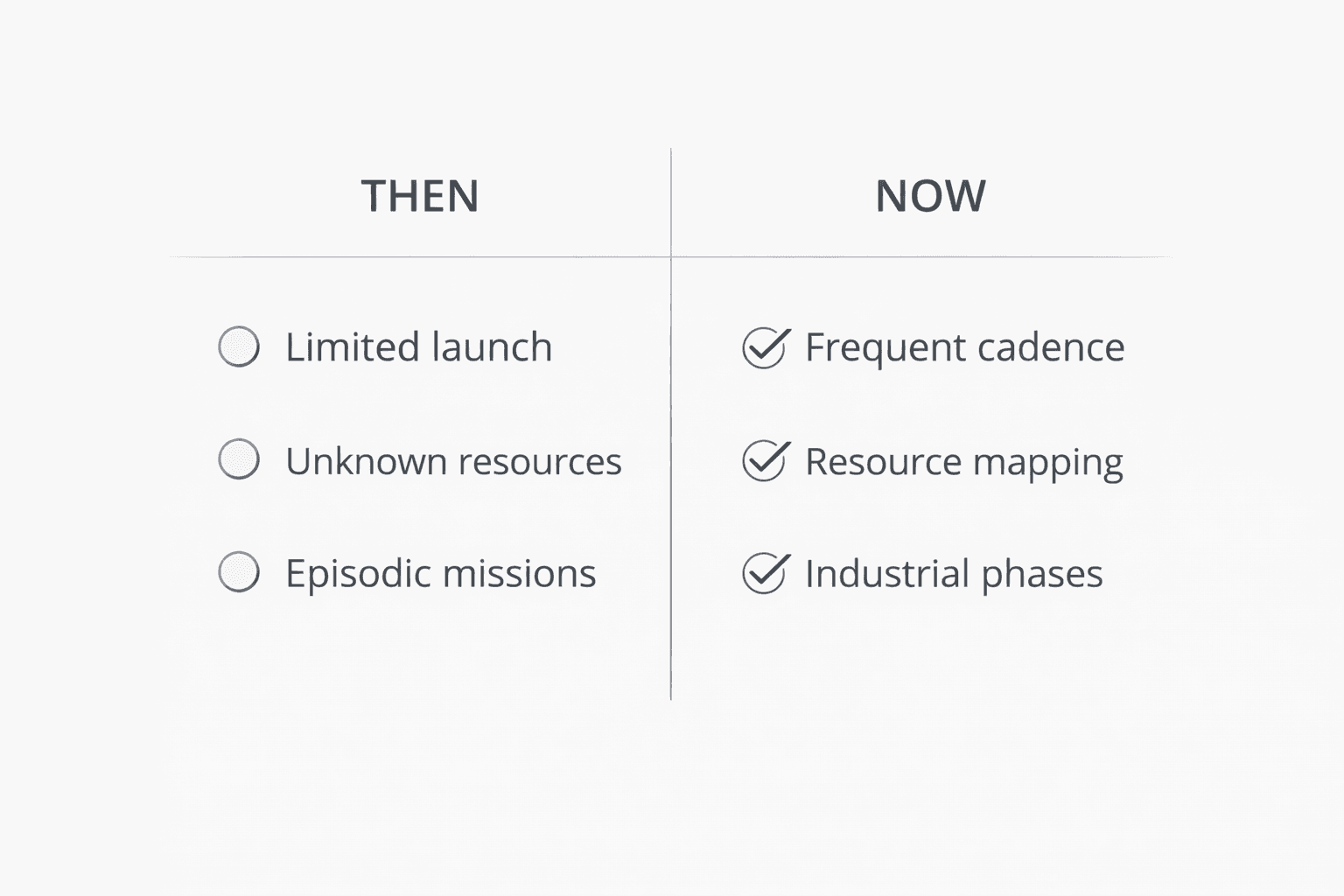
Lunar industrialization has been discussed for decades, but it remained impractical because the enabling conditions never aligned at the same time.


Earlier launch systems were optimized for exploration-class missions. They imposed strict mass, volume, and integration limits that made delivery of industrial-scale hardware infeasible. Systems had to be fragmented, assembled incrementally, or simplified to the point where meaningful throughput was unattainable.


At the same time, lunar resources were poorly characterized. While water and useful minerals were theorized, their location, concentration, and accessibility were uncertain. Industrial planning could not proceed without reliable resource confirmation.


Most critically, demand was episodic. Lunar missions were discrete events rather than components of a sustained infrastructure program. Without continuous institutional demand, there was no economic or operational basis for deploying permanent industrial systems.


Each constraint reinforced the others. Without heavy-lift access, resource extraction could not scale. Without confirmed resources, industry could not justify deployment. Without sustained demand, neither access nor resources translated into permanence.


The barrier was not technological ambition.

It was the absence of simultaneous alignment.
Then and Now

The Heavy-Lift Inflection

Industrial systems are constrained not only by total mass, but by how that mass can be delivered.


Earlier launch architectures imposed strict limits on payload size, mass, and integration. Industrial hardware had to be broken into smaller units, increasing on-orbit assembly, operational risk, and system fragility. These constraints made early industrial deployment impractical, even if long-term economics were favorable.


The emergence of fully reusable, heavy-lift launch capability changes this boundary. It enables the delivery of large, integrated industrial systems in fewer launches, reducing assembly complexity and increasing initial operational throughput.


This shift does not eliminate the mass constraint described earlier. Earth launch remains unsuitable for supplying bulk construction material. However, heavy-lift capability makes it possible—for the first time—to deploy the *industrial machinery itself* at a scale sufficient to begin local material production.


Heavy-lift launch therefore acts as an enabler, not a solution. It closes the access gap required to initiate lunar industry, while leaving long-term material supply to in-situ sources.

Resource Confirmation: Lunar Water

Industrial systems require resource certainty before they can be designed, deployed, or financed. For much of the space age, lunar water existed as a hypothesis rather than an input.


That uncertainty has now been resolved. Multiple missions have confirmed the presence of water ice in permanently shadowed regions near the lunar poles. These deposits are stable, geographically bounded, and accessible from nearby sunlit terrain suitable for sustained operations.


Water is not merely a life-support resource. It is an industrial enabler. It supports material processing, binding and consolidation techniques, dust mitigation, and closed-loop operations. In combination with regolith, it transforms lunar soil from inert material into a usable construction feedstock.


With confirmed water availability, lunar resources shift from speculative to actionable. Industrial planning can proceed on the basis of known inputs rather than assumptions.

The Demand Signal

Industrial systems only emerge where demand is sustained.


For much of the space age, lunar activity consisted of isolated missions with finite objectives and defined end dates. These programs generated exploration outcomes, not durable demand for infrastructure, materials, or industrial continuity.


That pattern has changed. The Artemis program represents a structural shift toward persistent lunar presence. Surface operations, logistics nodes, power systems, and habitation infrastructure require ongoing construction, maintenance, and material replenishment. These needs are not episodic; they compound over time.


This demand is reinforced by geopolitical realities. Multiple nations now treat cislunar space as strategically significant, driving long-horizon commitments rather than symbolic missions. As a result, lunar infrastructure planning is increasingly institutionalized within national programs and international partnerships.


Together, these forces create a durable demand signal. Industrial capability is no longer speculative—it is required to support sustained presence and operational continuity on the lunar surface.

Convergence

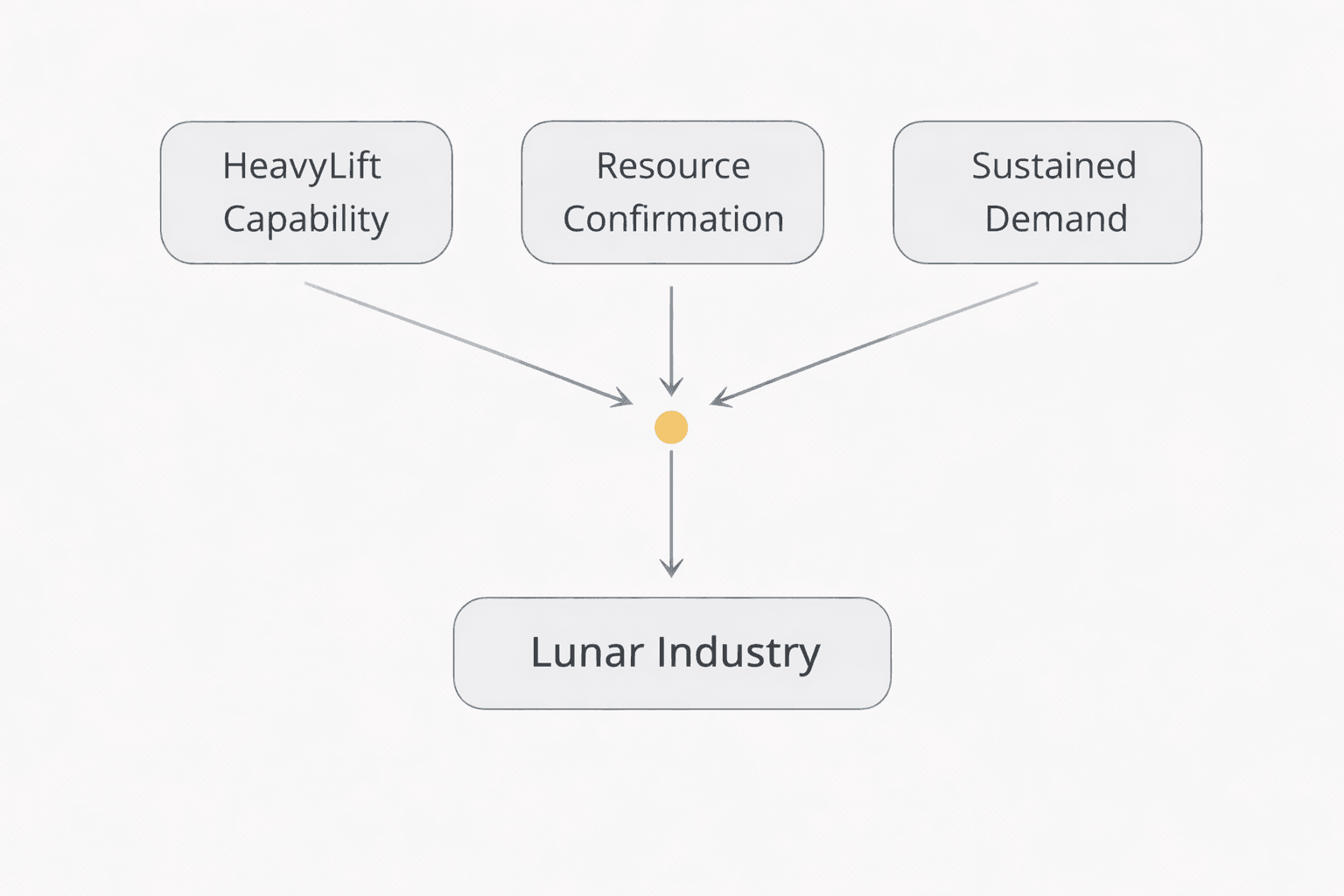
None of the preceding shifts is sufficient on its own.


Heavy-lift launch capability enables delivery of industrial systems, but it does not solve long-term material supply. Confirmed lunar resources enable processing, but without deployment capability they remain inert. Sustained institutional demand creates continuity, but without access and resources it cannot be met.


What has changed is not any single factor, but their alignment.


For the first time, access, resources, and demand exist simultaneously. Heavy-lift launch closes the access gap required to deploy industrial hardware. Confirmed lunar water closes the uncertainty around material inputs. Sustained programs such as Artemis close the demand loop required for continuity and scale.


Together, these shifts transform lunar industry from a speculative concept into a present engineering and logistics problem.


The question is no longer whether lunar industrialization is necessary.

It is whether it is built deliberately, or imposed later by constraint.

Lunar Industry